
Published: 10/25/2026
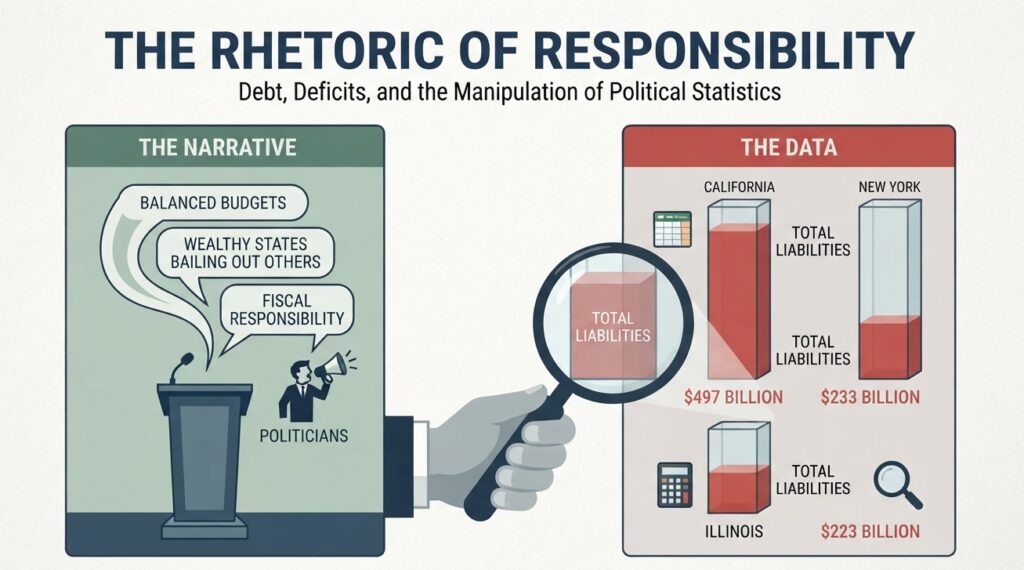
The three states with the highest absolute state-level liability burdens in the United States—California, New York, and Illinois—share a common political landscape. Comprehensive fiscal audits underscore the massive scale of these state-level obligations: California carries approximately $497 billion in total liabilities, New York holds $233 billion, and Illinois carries roughly $223 billion. Ironically, partisans in these long-time Democratic strongholds frequently champion their party as the true guardian of fiscal responsibility. A common narrative among these advocates is that their high-revenue states are continuously bailing out cash-strapped states controlled by the opposing party. This belief persists largely because voters have become accustomed to unverified claims from party officials—a systemic issue common to both sides of the political aisle.
To be clear, pointing out these local deficits does not imply that either major political party operates with genuine fiscal discipline. On the contrary, partisan spending across the board suggests an institutional lack of restraint. However, objective data can help dismantle inaccurate talking points. A direct comparison of state liability levels against regional political leanings quickly exposes the cracks in popular partisan rhetoric.
Critics note that arguments celebrating the financial superiority of these states rely heavily on aggregate numbers without analyzing their underlying components. The fact that the three most debt-burdened states are dominated by the Democratic Party undercuts the claim that their governance models represent fiscal sustainability. Furthermore, the notion that wealthy states directly subsidize others is a structural misconception; state governments do not make direct financial transfers to one another. Instead, these debates center on the net balance of federal spending. Meanwhile, the Federal Government itself relies on running perpetual deficits, issuing trillions in Treasury bonds to the public and financial institutions to cover its own compounding expenses.
Discussions surrounding whether a state has a “positive” or “negative” net cash flow with the federal government regularly overlook critical structural variables. Federal spending distributions are largely determined by the geographic concentration of federal infrastructure, not partisan charity. For instance, the presence of major military installations means that all federal funds spent on those bases—including specialized equipment, infrastructure maintenance, and the salaries of service members—are credited to that state’s federal influx. Similarly, defense contractors, munitions plants, federal civil service employees, and funding for Native American reservations and tribal health services all drive up a state’s total federal receipts. Broad cash-flow metrics are therefore a reflection of federal operational footprints rather than proof of direct state-to-state charity.
A similar pattern of data manipulation occurs within public safety metrics. Researchers increasingly warn that aggregate crime statistics can be unreliable because they only capture incidents that are officially reported and recorded. Variations in local reporting procedures, fluctuating community trust, and localized administrative backlogs can significantly distort these metrics. In several large urban jurisdictions, changes in how lower-level offenses are cataloged, combined with decisions by prosecutors to decline charges for certain non-violent infractions, create a statistical drop in reported crime that does not necessarily reflect an increase in public safety on the ground.
Ultimately, political figures routinely rely on selective accounting to shape public perception. Governor J.B. Pritzker of Illinois, for example, consistently claims to have balanced the state budget. Yet, while audited records show progress in reducing outstanding short-term bonds and clearing the state’s historical bill backlog, the underlying financial picture remains precarious. Illinois’ massive, structural unfunded pension obligations—which exceed $145 billion—continue to strain the state’s long-term balance sheet. These structural realities serve as a stark reminder of how easily political talking points can diverge from fiscal facts when partisan narratives are accepted without verification.